
Brilliant Science, Poor Communication - We Have a Training Problem
What I Learned Preparing My TEDx Talk on Science Communication

What if one of the biggest failures in science education isn’t what we teach but what we don’t teach?
In my recent TEDx talk, “Confessions of a Scientist: Science Education Needs Communication Training,” I unpack the uncomfortable truth that most scientists, myself included, are never formally taught how to communicate our work to anyone outside our field.
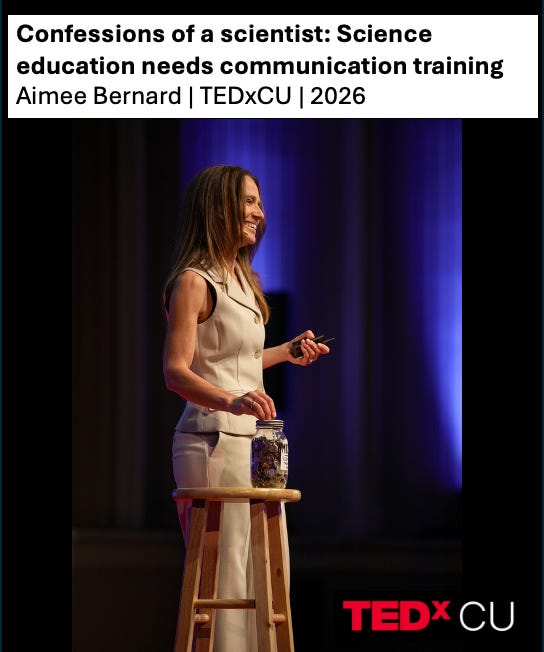
That gap has real consequences and matters now more than ever. From classroom experiences to real-world consequences, my talk explores how better communication isn’t just a ‘soft’ skill that should be acquired on the side. Science communication skills and training are essential for fostering public trust, bridging the gap between experts and communities, and ensuring that scientific discoveries don’t just stay behind the walls of academia and paywalls of journals. Our science should be communicated in plain language to inform decisions, shape policy, and translate scientific knowledge into real-world impact that benefits society.
This talk is both a personal reckoning and a call to rethink how we train scientists and medical professionals for the world we actually live in.
YouTube: Confessions of a Scientist: Science education needs communication training
If you are so inclined, please watch, hit the ‘like’ button on YouTube, and share it far and wide with friends, family, neighbors, colleagues, your crazy uncle, people you like and maybe even people you don’t like (hee hee) – this message needs to shared far and wide and heard by everyone both on the inside and outside of science.
Later this week, I’ll break down key moments and ideas from the talk in more detail. For now, I’d love for you to watch and reflect alongside me. Let’s band together to fight for science communication skills and training to be added to graduate and medical education.
THANK YOU for being here :)
ps - the TEDx video editor chose an ‘interesting’ cover shot for the video ;)
Not sure if I was closing my eyes in deep thought or from the blinding stage lights?!
Great work. Communication is essential for being part of the scientific community. As a "soft skill" it's been increasingly incorporated into curriculum. At MIT I taught out of the Writing Rhetoric and Professional Communication (WRAP) for twenty years. Students have to fulfill a communication requirement that included taking specific courses in their disciplines that were "communication intensive." In these courses, my collueagues and I would team teach with the technical faculty, introducing the students to the genres and having them produce their work in disciplinary documents, whether journal articles, NIH style grants, poster sessions, presentations to audiences ranging from an academic session to ventur capital, to gov't agenices. In similar forms, these activities and requirments have been growing across science disciplines.