
Half Foreign, Fully Protected: Recalibration of the Immune System During Pregnancy
A look at the elegant immunological negotiation that makes pregnancy possible, from implantation to birth.


This article is a collaboration with Unbiased Science, dedicated to breaking down complex health and science topics through patient, evidence-based explanations that respect both skepticism and nuance, and Selfority, dedicated to providing clear, evidence-based guidance from a board certified OB-GYN (Sarah Berg, MD) to women navigating the menopause journey and the workplaces that need to understand it.
It was 3 a.m. on a Tuesday when my (Sarah) phone rang while I was on call. On the other end was a first-time mom in her second trimester, breathless with worry before she even finished saying hello.
She’d spent the weekend helping her sister, whose three-year-old had a cough. I never get sick, she told me, so she hadn’t thought much of it at the time. But now she had a cough of her own and a fever hovering at 101. Her obstetrician had given her a list of medications considered safe in pregnancy. Acetaminophen was on it. And yet she hadn’t taken it.
She’d read online that Tylenol (acetaminophen) could be bad for her baby. She didn’t want to do the wrong thing. So she worried through the day, worried through the night, and finally, after hours of fretting, called the office. And there we were, in the quiet of early morning, talking about fever and acetaminophen in pregnancy.
This wasn’t a one-off experience, either on call or in the office. But it stayed with me because of how much stress she carried into that call—and how clearly it was rooted in care. All she wanted was to do the right thing for her pregnancy.
What she was carrying that night was a contradiction we hand pregnant women all the time. We tell them their bodies are doing something powerful and miraculous, and in the next breath we tell them their immune system has gone soft and needs protecting. We talk about pregnancy as powerful and its immune system as fragile. Both ideas can’t be true at the same time, right?
So what is actually happening to the body and immune system during pregnancy? And why does the idea of immune weakness persist, even when biology tells a far more remarkable story? Pregnancy isn’t a failure of the immune system; it’s one of the most sophisticated examples of what the human body can do.
Reframing Pregnancy as a Physiologic Adaptation with Immune Recalibration
When I (Aimee) teach first-year medical students about pregnancy and the immune system, I ask them to explain a massive biological paradox: how does an immune system designed solely to seek and destroy invaders tolerate a “guest” that is fifty percent foreign for nine whole months? The developing fetus carries the other parent’s DNA, meaning it’s essentially an unmatched transplant. By all accounts, the body’s defenses should reject it instantly. But instead of attacking, the maternal immune system shifts gears to tolerate and protect it. Someone always asks how that is even possible, and that question is the whole subject. The pregnant body isn’t weakened, it’s recalibrated. This is especially true of the immune system.
The immune system is strategically adjusted to allow a genetically distinct non-self (half‑foreign) fetus to grow within the body while still defending the pregnant parent - and developing fetus - from infection. Some immune responses are intentionally dialed down, such as certain T‑cell–mediated responses that normally attack foreign cells become less aggressive, and inflammatory pathways that could threaten the developing placenta are kept in check. None of this is the immune system stepping back. It is the immune system doing something more challenging - to decide what to tolerate and what to fight.
Physiology Meets Immunology: Pregnancy Requires Precise Coordination
Pregnancy transforms nearly every major body system. The cardiovascular system increases its blood volume dramatically, the respiratory system adapts to bring in more oxygen, and metabolism rewires itself to fuel both parent and baby. And then there’s the placenta, an entirely new, temporary organ that anchors the pregnancy, delivers nutrients, removes waste, and communicates constantly with the immune system. It’s important to distinguish the placenta from the uterus: the uterus is the pregnant parent’s own organ, while the placenta is composed of fetal tissue that embeds within the uterus. That distinction matters, because the immune system must recognize the placenta as genetically distinct (aka ‘foreign’) yet avoid attacking it. These coordinated physiologic changes highlight how pregnancy relies on immune cooperation and adaptation, not immune shutdown.
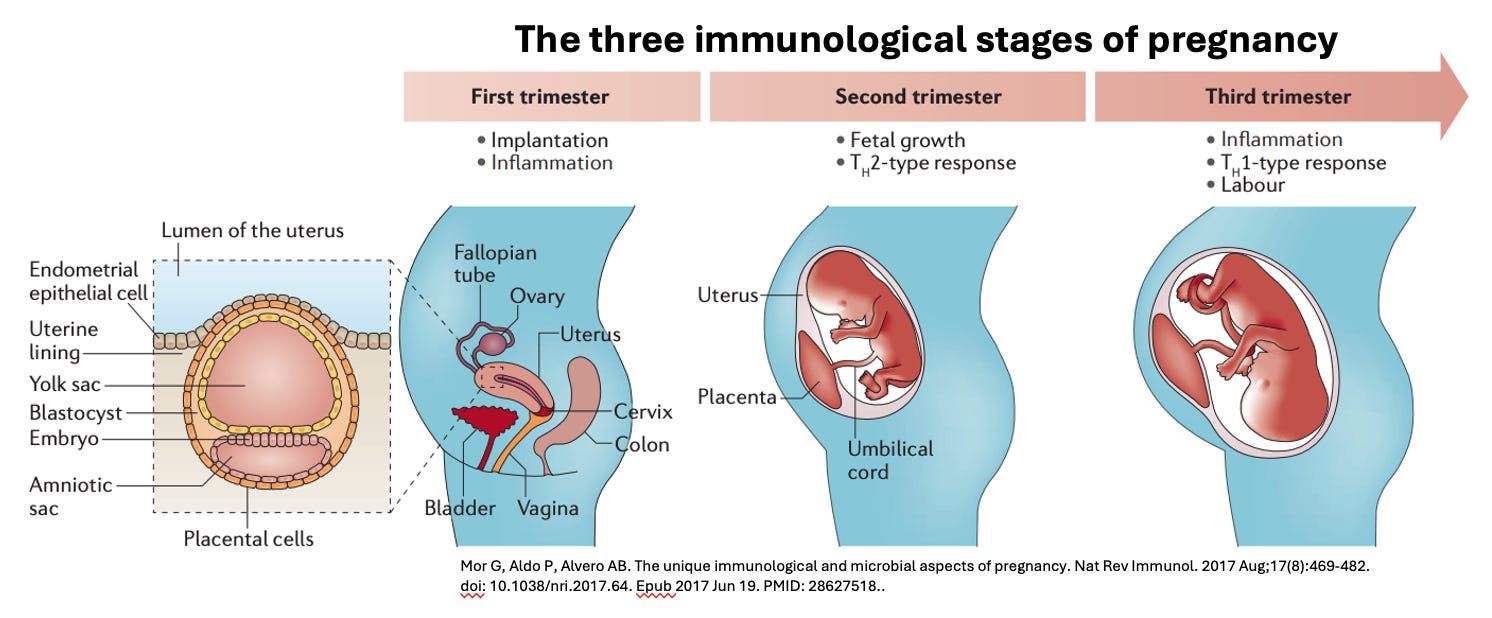
To support a developing fetus, the immune system adopts a finely tuned balance between protection and tolerance. Some of these changes happen locally, right at the maternal–fetal interface, where specialized immune cells help the placenta grow and prevent harmful inflammation. Uterine natural killer (uNK) cells, for example, are not the aggressive infection‑fighters we typically associate with NK cells. NK cells elsewhere in the body detect and destroy ‘altered self’ cells. They are known to hunt down altered self cells that are virus-infected or cancerous and destroy them. You would expect a population of killers to be the last thing you want crowding around a half-foreign organ. Instead they show up to the maternal-fetal interface in pregnancy and take on a nurturing role, helping remodel blood vessels so the placenta can deliver oxygen and nutrients to the fetus. Another key player is the population of regulatory T cells (T‑regs), which expand during pregnancy to promote tolerance and keep maternal T cells from mistakenly targeting fetal tissues. Meanwhile, systemic immunity remains active, allowing the pregnant parent to respond to infections. This state is best understood as immune tolerance, not immune failure: the body is deliberately learning to live with something partly foreign while keeping its defense system online.
Maternal Vaccines Power Immune Protection
One of the most remarkable outcomes of this immune partnership is the transfer of protective antibodies across the placenta in later pregnancy, giving newborns their first immune shield after birth, a process that becomes even more powerful when the pregnant person receives the recommended maternal vaccines. Vaccination during pregnancy against influenza, COVID‑19, RSV, and pertussis (through the TDaP vaccine) prompts the maternal immune system to generate high‑quality, antigen‑specific antibodies that readily cross the placenta and protect babies during their most vulnerable early months. These vaccines are strongly recommended by leading medical organizations because they reduce severe disease in the pregnant person and provide essential passive immunity to the newborn. For example, ACOG emphasizes that maternal immunization, particularly for influenza, COVID‑19, and RSV, prevents severe respiratory illness and improves neonatal outcomes, while TDaP during pregnancy is crucial to protect newborns from pertussis before they can be vaccinated themselves.
By intentionally stimulating the immune system during pregnancy, these vaccines work with the body’s built-in immune defenses to provide protection. Pregnancy isn’t an immunologic weakness; it’s an elegant reorganization of local and systemic immune components that support both parent and baby, and maternal vaccination leverages that system to provide life‑saving protection during pregnancy and the first several months of life of the newborn after birth.
What Actually Supports the Immune System in Pregnancy
Vaccination, Nutrition and Sleep! Oh My!
Supporting immunity in pregnancy isn’t about trying to bolster something deficient; it’s about providing what an exquisitely tuned biological program needs to operate. In practice that comes down to three things we tend to underestimate: vaccination, nutrition, and sleep.
Vaccination
One of the clearest examples is vaccination. Contrary to the myth that pregnancy blunts immune responses, pregnant people consistently generate robust antibody responses to recommended vaccines: including influenza, COVID-19, RSV, Tdap, and Hepatitis B. Those antibodies don’t just protect the pregnant person. They cross the placenta and enter fetal circulation, conferring passive immunity to the infant after birth, often for months, during the window before a baby can be vaccinated themselves. The non-live vaccines we recommend during pregnancy are safe and effective precisely because they engage an immune system that can respond and should be recruited to protect both mother and baby.
Nutrition
Nutrition plays a similarly foundational role. Plasma volume increases by more than 40 percent during pregnancy, which drives a dramatically increased demand for iron to maintain oxygen delivery. Inadequate iron undermines both oxygen transport and the capacity of immune cells to do their work. Folic acid supports DNA synthesis and cell division throughout the body, including in immune cells. Calcium, magnesium, zinc, vitamin D, and iodine all matter too.
Nutrients from food tend to be better absorbed and used than the same nutrients taken in isolation, in part because they arrive together, in the proportions and chemical forms the body is built to handle, alongside fiber and other compounds that shape how they’re processed. Prenatal vitamins and a small number of targeted supplements fill specific, well-documented gaps, folate and iron chief among them. But more is not better, and the instinct to take everything just in case is worth resisting. Many supplements are unnecessary in pregnancy, and some carry real risk, in part because the FDA does not review supplements for safety or effectiveness before they reach the market. A manufacturer sets the dose, makes the product, and sells it; the agency generally steps in only afterward, once a product already on the shelf turns out to be contaminated or mislabeled. That regulatory gap is exactly why the supplement aisle is the wrong place to improvise. Your OB-GYN can tell you which supplements you actually need and which to skip.
Sleep
Sleep and stress are often framed as lifestyle variables. Biologically, they are core regulators of immune function. During sleep, particularly slow-wave sleep, the immune system shifts toward processes that support long-term defense: regulating inflammation, consolidating immune memory, coordinating the signals that keep adaptive immunity sharp. Disrupted sleep pulls the system toward a more pro-inflammatory state and weakens immune responsiveness, effects that have been documented in reduced antibody responses to vaccines even in otherwise healthy adults.
Chronic stress operates through similar pathways. Sustained activation of stress responses leads to prolonged cortisol exposure, which dysregulates immune signaling and pushes cytokine profiles toward persistent inflammation. Sleep disruption and chronic stress do not simply weaken the immune system. They distort it, pulling it away from the finely tuned adaptations pregnancy requires. Seen this way, prioritizing sleep and managing stress aren’t peripheral wellness advice. They are integral to pregnancy care.
What Disrupts an Already Calibrated System
Many of the things that disrupt immune function during pregnancy are not exotic or mysterious. They are constraints on a system already operating at high demand.
Nutrient deficiencies are a clear example. Immune responses depend on rapid cell division, protein synthesis, and tightly regulated signaling, all of which require adequate micronutrients. During pregnancy, those demands increase alongside expanded blood volume, placental growth, and fetal development. When iron or folate is insufficient, the immune system isn’t weakened so much as under-resourced, creating bottlenecks in processes that would otherwise run smoothly. That effect can extend to the newborn, because nutritional deficiencies in utero can impair the baby’s immune response after birth.
Chronic stress and poor sleep work the same way, quietly and cumulatively, nudging the system toward persistent inflammation instead of the balance pregnancy depends on. The effect is easy to miss precisely because it is gradual, which is part of why it gets dismissed as something a pregnant person should simply tough out.
Underlying medical conditions add complexity. Autoimmune diseases, metabolic disorders, and the medications used to manage them all shape baseline immune activity. These factors don’t negate immune adaptation, but they change its starting point and deserve individualized attention.
Fever is perhaps the most misunderstood disruptor of all. It is a normal physiologic response to infection. But in pregnancy, sustained fever carries real risks, particularly during sensitive windows of fetal development. So treating fever while pregnant is important. Ibuprofen is contraindicated in pregnancy, leaving acetaminophen as the primary option. Treating fever with acetaminophen is not about suppressing the immune system or increasing long term diagnosis in the fetus. It is about responding to a physiologic signal in a context where unchecked fever is itself the danger. The data support this clearly: managing fever is part of protecting both maternal and fetal health. This is what I (Sarah) found myself explaining at 3 a.m. to the mom with the 101 fever. She had a safe medication sitting in her cabinet and a fever doing real harm, and she had talked herself into the more dangerous of the two options because a headline told her the safe one wasn’t safe. I (Sarah) told her to take the acetaminophen. Then I stayed on the line a while longer, because the fever was never really the thing keeping her up. The fear was.
Pulling the Threads Together: Adaptation, Not Fragility
The factors that disrupt immune balance in pregnancy don’t point to a system that is fragile. They point to one that is responsive, context-dependent, and worthy of thoughtful care.
Pregnancy asks the body to do something rare in human biology: to undergo sweeping physiologic change while maintaining immune vigilance and restraint at the same time. Blood volume expands, metabolism shifts, and a temporary organ (placenta) forms to support a developing fetus. In response, the immune system adapts: locally recalibrating tolerance, systemically maintaining defense, and coordinating signals across multiple organ systems. These changes are not competing processes; they are integrated ones. The body changes, the immune system responds, and together they protect pregnancy.
This coordination is not new or experimental. It reflects a system shaped and refined over evolutionary time, one that has been tested across countless pregnancies long before modern medicine began to observe it. That does not mean pregnancy is without risk, or that medical care is unnecessary. It means that the baseline state of pregnancy is not one of breakdown, but of design: complex, responsive, and resilient when supported appropriately.
Final Thoughts
When confusion arises, it is rarely because pregnancy biology is inherently fragile. More often, it is because incomplete or distorted information gets layered onto a system that is already doing something demanding. Advice meant to “avoid harm” can inadvertently create fear. The result is not better protection, but more anxiety. Like the 3 a.m. conversations that grow out of uncertainty about what is truly safest to do. This is the same misunderstanding that turns pregnancy-recommended vaccines, designed to engage a responsive immune system and extend protection to the newborn, into sources of doubt rather than reassurance.
Pregnancy is one of the most sophisticated physiological challenges the immune system successfully accomplishes.
Understanding pregnancy as adaptation rather than weakness changes the frame entirely. It allows us to see evidence-based supportive care not as interference, but as partnership with biology.
The immune system doesn't retreat during pregnancy — it adapts, negotiates, and rises to the occasion. That's not a vulnerability to manage. That's a triumph worth marveling at.
Stay curious!
 | A guest post by
|
I am delayed in asking...needed to find my 'summary question'. If my information is not correct please clarify, thank you.
Given the sad state of likely global immunizations, specifically measles I have read the passive immunity from mom to newborn is not very good... convention being "protective" maternal antibodies are present ~ 9+ months post birth. However, titres are minimal within a couple months. I find it counterintuitive, what I read indicated mom's with natural immunity may offer their new born a shorter window of passive antibodies cf those who were vaccinated with MMR.
This may be simply an academic exercise yet there is a vast number of newborns who are especially vulnerable to contracting measles & no fault or lack of due diligence on the part of their mothers.
I am also aware MMR vaccine effectiveness with early vaccination is lower than with vaccination at 14 mo's ( ~76% at 6 mo's, rising to 95% at 9 months) with permanently reduced antibody titers at a later age, even after follow-up vaccination(s). These effects are greatest when vaccinated at 6 months of age and decrease as vaccination occurs at a later age. In addition, to those who receive the MMR prior to the established timing for their 1st dose, any previous dosage is MMR0.
Clearly, we cannot vaccinated pregnant women but we could discuss a 'booster dose' of MMR such as the recommended RSV (late 2nd or early 3rd trimester), as such off-label.
OMG the tragic consequences of a newborn contracting measles.
Appreciatly your, JJF Phm 🇨🇦
Respectfully, Dr. Bernard I am aware of what you outlined & apology for not be clearer in my question or concern for what I believe is the majority of not a large percentage of newborns are susceptible to contracting measles.
The conventionsl paradigm being babies born to mother's who have developed measles antibodies from natural exposure or vaccination are protected throughout their initial "12 months" is flawed if I understand correctly from what I have read.
These passive antibodies wane significantly during the initial post partum period such that their is limited protection after 3-6 months.
If my understanding is correct (stand corrected) newborns would have little to no competing maternal antibodies post 6 months from delivery. Once again if this has been established should we not be evaluating when the recommended 1st dose of MMR should be offered/administered. This would then not be considered MMR0.
Appreciatively yours,
John