
Reimagining Science Training for a Changing World
Empowering the Next Generation of Science Communicators

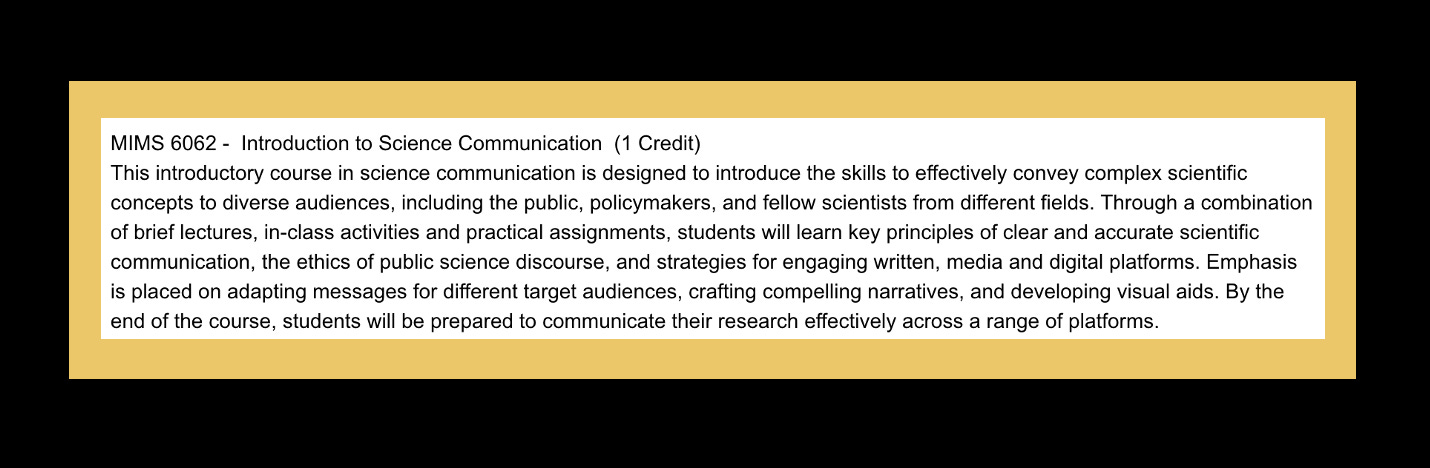
Today marks an exciting milestone in my career - I am offering the first-ever for‑credit course in science communication at CU Anschutz. My course is called ‘Introduction to Science Communication’ designed specifically for students working toward their master’s degree within the immunology and microbiology program. While the title (Introduction to Science Communication) may sound simple, its existence represents something much bigger: the beginning of embedding science‑communication training directly into the curriculum for scientists in training!
For many of us in science (me included) communication about our science wasn’t something we were taught. It was something we pieced together in the cracks of our schedules, learned through trial and error, motivated by a sense of responsibility to the public and a genuine love for sharing the wonder of scientific discovery. For the past 20 years, I’ve written blogs, op-eds and guest commentaries in between experiments, answered community questions after hours and on weekends, practiced explaining my research (and everything related to vaccines) to friends and family, and hoped I was doing more good than harm.
Over time, communicating science has become embedded into my way of being as a scientist, and this commitment has naturally evolved into me being seen as the go-to person for training in science communication. As public trust in science continues to decline, the demand for clear, accessible, evidence-based communication has surged. In response, I am frequently invited to give seminars, workshops, grand rounds, and keynote speeches - far more invitations and opportunities than I have the capacity to accept. This growing need underscores both the urgency of effective science communication training and the value of cultivating scientists who can engage diverse audiences with clarity, empathy, and credibility.
From my vantage point, working at the intersection of science and public engagement, it is evident that the world has changed, and our scientific training must change with it.
Today’s scientists are expected not just to generate knowledge, but to communicate it clearly and compellingly to a wide range of audiences, including policymakers, journalists, interdisciplinary colleagues, and the public.
The stakes are high. Public health, climate change, scientific funding, biomedical innovation, and public trust in science all rely on communication that is accurate, accessible, and empathetic. Yet most emerging scientists still receive no formal preparation in these skills.
My course aims to change that.
What the Course Offers
Introduction to Science Communication provides students with the foundational skills to communicate complex ideas to diverse audiences. Through short lectures, hands‑on activities, and practical assignments, students will learn:
The core principles of clear, accurate science communication
How to adapt messages to different audiences
How to build compelling narratives around scientific ideas
The ethics of public engagement and responsible discourse
Strategies for writing, media interviews, digital communication, and visual storytelling
By the end of the semester, students won’t just understand how to communicate, they’ll have experience doing it, tailored to diverse audiences across a variety of formats.
Why This Is a Turning Point
To me, the most significant part isn’t the course content (though I’m proud of it). It’s what this course signals: a shift toward recognizing communication as an essential scientific skill, not an optional extracurricular hobby. A shift toward valuing the time and effort scientists spend engaging with communities. A shift toward preparing trainees not only to succeed in academia, but to share the impact of their work with society.
My hope is that this course becomes the first of many and that it helps normalize the idea that scientific training includes learning to communicate with clarity and confidence to the general public. That students (and academic institutions across the globe) see science communication not as an add‑on, but as an integral part of becoming - and being - a scientist.
Agree absolutely. From my perspective it isn’t necessarily the lack of skill in communicating per se, most scientists can and do communicate with their peers, but it is the skill in making complex ideas available to the general public in a way that is neither too technical or, possibly worse, patronising. If your course can achieve that then you are onto a winner. If you’re looking at the medical field, for example chronic conditions or other complex conditions, then involving people who have experienced discussions with their physician about their specific condition may be useful as they can describe what they found useful and what aspects of the discussion that confused them or were too vague or they felt they weren’t listened to, the concept of the expert patient. Communication is a two way process.
I wish this course was available in every university setting!