
Science Communication: The Scientist’s Guide to Scaling Your Message
A 5-Tier System for Translating Your Science

One of the most strange side effects of becoming an expert is forgetting what it feels like not to know what you know. Concepts that seem obvious to you, like immune responses, gene expression, and signal transduction, can sound like a foreign language to everyone else.
One of the reasons behind this communication gap is that scientists spend years learning how to communicate with other scientists but rarely or, in most cases, never trained to explain our work to a neighbor, a parent, or the person sitting next to us on a plane. Suddenly, all of our usual communication tools stop working.
Effective science communication begins when we stop focusing on what we want to say and start thinking about what our audience needs to hear.
As a PhD immunologist and medical educator, I’ve seen firsthand how difficult and important it is to communicate science clearly. Whether I’m teaching future health professionals, talking with members of the public, or developing science communication resources, I’ve learned that expertise alone isn’t enough. Effective communication starts with understanding your audience and finding ways to connect new ideas to what they already know and care about.
Scientists are trained to communicate with precision, accuracy, and efficiency using technical language (aka ‘jargon’) specific to our fields. We’re rarely trained to adapt our science (and technical language) into easy-to-understand, clear language that resonates across a variety of audiences. As a result, our messages don’t always land the way we intend.
I’ve seen this challenge repeatedly throughout my career. And it’s not because scientists aren’t good communicators, but because we’re communicating exactly the way we were trained. The problem is that the same explanation that works for a colleague at a conference is unlikely to work for a patient, a policymaker, a journalist, or a curious neighbor.
The key is to start with your audience and adjust your explanation accordingly.
To help trainees develop this skill, I created a practical five-tier framework that helps scientists translate their work for different audiences without sacrificing accuracy or meaning. I originally developed this approach years ago while mentoring graduate and medical students who were struggling to explain their research beyond the classroom or laboratory. Since then, I’ve found it to be a useful tool for anyone looking to communicate science more clearly and effectively.
Why We Need a Multi-Tiered Approach
One of the biggest challenges in science communication is that there’s no single version of an explanation that works for every audience. The way I would explain the immune system to a colleague, a medical student, a journalist, or a middle school student would look very different.
I’ve noticed that scientists often struggle at either end of the spectrum. Sometimes we lean too heavily on technical language because that’s how we’ve been trained to think and communicate. Other times, in an effort to make our work accessible, we simplify so much that we strip away important context, nuance, or uncertainty.
Effective science communication isn’t about making science simpler for the sake of simplicity. It’s about making it understandable and relevant for a specific audience while preserving the integrity of the science. I like to think of science communication as a process of translation rather than simplification. With each step, you’re challenged to identify what is truly essential, refine your language, and connect your message to what your audience already knows and cares about. The goal is to meet people where they are without losing the accuracy, meaning, or the wonder of the science itself. This is a much more challenging task than it sounds.
One of the most common mistakes in science communication is swinging too far in either direction: some scientists overwhelm their audience with dense, jargon-heavy explanations that can feel exclusionary or elitist, while others overcorrect by simplifying so much that their message comes across as condescending. Yikes! Neither of these outcomes allow the audience to feel connected to our science.
The real skill lies in finding the balance between these extremes, and that balance depends entirely on your audience. A useful way to think about this is as a process of progressive translation through a multi-tiered approach. With each step, you are forced to clarify your own thinking, identify what truly matters, and adjust your language without losing the core intent of the message. The goal is not simplification for its own sake, but alignment and meeting your audience where they are while doing your best to maintain the integrity and nuance of the science.
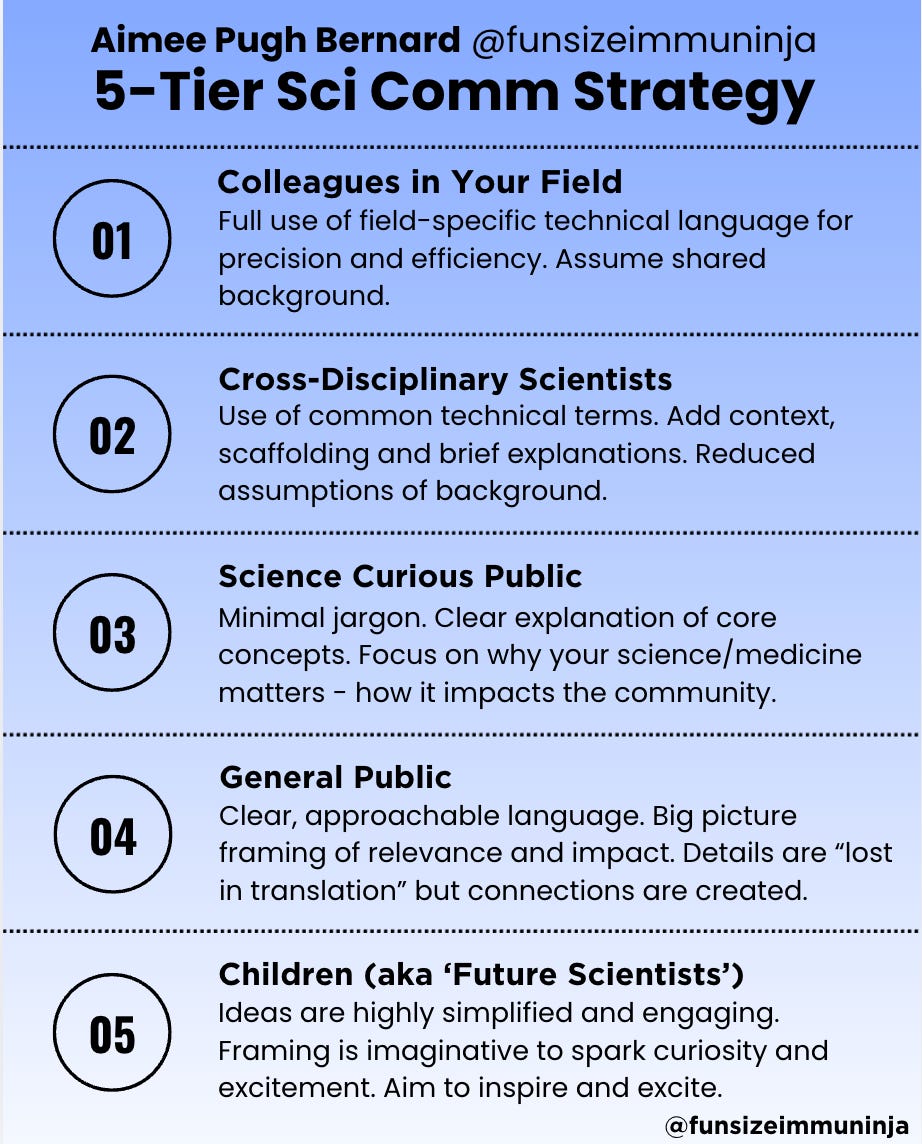
Let me introduce my 5-tier framework for translating your science to fit your audience…
» The 5-Tier Framework
Tier 1. Colleagues in Your Field
Explaining your work to a colleague the way you’ve been trained to communicate in your discipline.
Full use of jargon and technical terminology (unrestrained!)
Assumes shared background knowledge
Prioritizes precision and specificity
I always recommend starting with this tier as it is your source material. After years of training in your field of expertise this tier comes most naturally. The use of technical language or jargon has a purpose: it’s precise and efficient but it’s only effective for a very small audience – the people in your field and area of expertise – and needs further translation for other audiences.
Tier 2. Cross-Disciplinary Scientists
Explaining your work to a scientist in a different field.
Some technical terms remain, but require brief explanations
Adds context and scaffolding
Reduces assumptions about shared knowledge
I recommend moving to Tier 2 as the next step in translation. Here you translate your science without fully simplifying but do need to add a bit of context and unpack some of the science.
Tier 3. Science-Curious Public
Explaining your work to people who are curious about science. A good point of reference here might be people who read Scientific American or the science section of a newspaper.
Minimal jargon
Clear explanations of core concepts
Focus on why it matters – meaning and impact
I recommend moving to Tier 3 as the next step in translation. Shift is to focus less on methods and how you arrived at your scientific findings. At this level, focus more on meaning and impact. People care less about how you did it and more about what it tells us. Focus on how your science solves a problem or fills a gap in knowledge and, most importantly, how it impacts the world around us.
Tier 4. General Public
Explaining your work to people with no assumed science background. A good point of reference may be a family member or friend who you know does not have a background in science. Keeping in mind someone you have a relationship with as you translate for this tier can be helpful as you can cater the conversation (in your head or on paper) to this person you have in mind.
Clear, everyday language
Big-picture framing
The use of sci comm tools, such as analogies and metaphors, can be useful here
Emphasis on relevance and clarity
I recommend moving to Tier 4 as the next step in translation. Shift is to focus on understanding and connection. At this level, focus on the relevance of your science to the world outside of the laboratory as well as making connections that inspire understanding. Making connections (to the person and to the science) is where trust in science is built.
Tier 5. Young Audience (aka ‘Future Scientists’)
Finally, you’re translating your work for children – our future scientists!
Highly simplified ideas
Imaginative framing
Energy, curiosity, and excitement
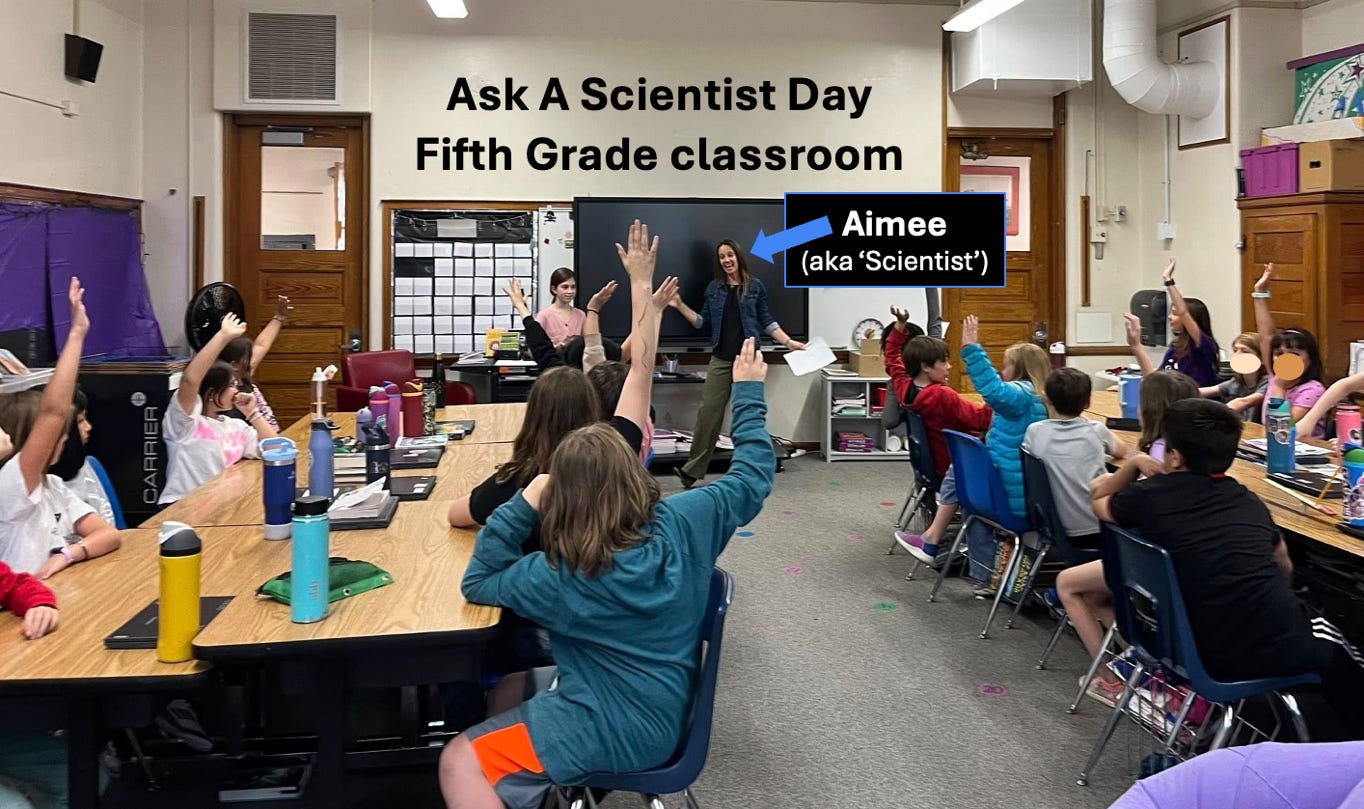
I recommend moving to Tier 5 as the final step in translation, even if you don’t intend to explain your work to a classroom full of 5th graders (see screenshot below). At this level, you are no longer just explaining your science - you are inspiring the next generation!
What This Looks Like in Practice
Let’s take a single concept and move it through all five tiers.
Prompt. How mRNA works inside a cell
Tier 1. Colleagues in Your Field
mRNA is transcribed from DNA in the nucleus and exported to the cytoplasm, where it serves as a template for translation by ribosomes. Codon–anticodon pairing with tRNA facilitates the sequential addition of amino acids to form a polypeptide chain. Post-translational processing then determines the protein’s final structure and function.
Tier 2. Cross-Disciplinary Scientists
mRNA carries genetic instructions copied from DNA and moves from the nucleus to the cytoplasm. There, ribosomes read the mRNA sequence in sets of three bases and, with help from tRNAs, assemble amino acids into a protein. The protein then may undergo further processing and fold into its functional form.
Tier 3. Science-Curious Public
Inside cells, messenger RNA (aka ‘mRNA’) acts like a temporary set of instructions copied from DNA within the nucleus or center of the cell. From there, the mRNA travels out of the nucleus and finds a ribosome, which reads the instructions and builds a protein piece by piece using building blocks called amino acids. These proteins are then used by the cell to keep the cell functioning.
Tier 4. General Public
Inside every cell in our body is a ‘messenger’ that we call messenger RNA, or mRNA for short. mRNA is like a recipe copied from the cookbook of DNA, that contains the genetic instructions for everything our body needs to function. mRNA recipes are only copied from the DNA cookbook when they are needed. Machinery in our cells, called ribosomes, read the mRNA message and use it to build proteins. One example of a protein we need to make every day is insulin. Insulin breaks down sugar from the food we eat into energy.
Tier 5. Young Audience (aka ‘Future Scientists’)
DNA is the cookbook that contains all the instructions for life. We have a DNA cookbook in every cell inside our bodies – heart cells, lung cells, skin cells, brain cells – all the cells! mRNA is like a recipe card inside your cells for tiny machines called proteins that help our cells stay alive and working. To make proteins, the cells in our body follow the mRNA recipe step by step until it’s done and the protein is made. A fun fact about mRNA is that after the cell uses the recipe card to make all the protein it needs for the task at hand, the mRNA recipe card gets thrown away! If that protein is needed again later on, the cell copies off a new mRNA recipe card from the DNA cookbook.
How to Use This Framework
Here’s a simple way to apply this to your own work:
1. Start at Tier 1
Write your explanation as you normally would for your field.
2. Translate tier-by-tier
Move down one tier at a time and don’t skip any tiers. Each level forces you to rethink and distill your message.
3. Identify what changes
What terms did you remove or define?
What details did you keep or discard?
Did your emphasis shift from mechanism to meaning and/or impact?
4. Practice regularly
Take one sentence from your current work and rewrite it across all five tiers. I encourage my mentees to do this with convoluted titles from journal articles.
The more you practice, the faster and easier this process becomes. If you do this often enough, you will easily be able to slide from one tier to the next without much difficulty. incredibly powerful.
Common Challenges and Ways to Reframe Your Thinking
“I don’t want to oversimplify my work.”
You’re not removing accuracy, you’re changing emphasis.
“I don’t know how to make my science accessible.”
Accessibility isn’t a natural talent that you are either born with or not, it’s a skill built over time through iteration and trial-and-error.
“This takes too long.”
This process actually saves time by clarifying your thinking for talks, grants, funding pitches, teaching, and writing. All the things we scientists do and care about in our profession.
Call to Action! Try It Yourself
Pick one concept from your current research and run it through all five tiers. You may be surprised at what you discover - not just about how to explain your work, but about how well you understand it yourself.
The best science communicators aren’t simpler thinkers. They’re better translators.
LIKE!
I find myself, as do many colleagues, spending 50% of my consulting time debunking what our clients tell us they know and use for their decision-making. Much of their misunderstanding is because they have learned, and accepted as true, both pseudo-science and misinformation, i.e., other people's wrong interpretations. However, the biggest factor is their lack of foundation science - they do not have the concepts of biology, chemistry, physics, or statistical analysis not to mention data collection methodology.
Doctors, with creds like MD's, OD's, and medical practitioners like RNs, Nurse Practitioners (who can diagnose and prescribe pharmaceuticals), and various "health and wellness community" influencers and providers like naturopaths, dietitians, nutritionists, chiropractors, supplement sales, all your various true-blue charlatans, and many others have zero education in data methods - this means they can't analyze scientific literature with the skills for critiquing and understanding the meaning of data and how it's collected.
This makes communication quite harrowing indeed - they hire us, trust us, for our science that they "need" - and then, rebuke us, ostracize us, and get angry when we do not fit their non-science narrative with our science-based critical thinking.
Debunking is necessary but also confrontational.
I'd love to see these types of scenarios fit into your paradigm. "Simplification" to their level of knowledge is far more complicated than your process allows. There is not "Level" for pseudo-knowledge. Think about it - MD's have more years of "science"-based education yet are some of the most staunch adherents to pseudo-science and are easily swayed by the charlatans when the language of "sales" is couched in a technical science-y word salad.
Thanks, printed the strategy chart to remind me so I am not unconsciously crawling back to tier 1