
Scleroderma Explained - Living with a Rare, Invisible Illness
Exploring the science, symptoms, and lived experiences behind this often-overlooked disease

April English*, Aimee Pugh Bernard, Leigh Baxt, and Jess Steier
This article is in collaboration with Immunology Explained, an initiative by the American Association of Immunologists (AAI) to connect you to the science behind your health.
*This article is written through the lens of April English, an amazing and resilient person living with Scleroderma. The science elements were fact-checked and lightly edited for accuracy by Aimee and Leigh.
As a person living with Scleroderma (April), it’s hard to put into words what living with an autoimmune disease is like, let alone an invisible one. Most people picture someone with a chronic autoimmune disease as visibly unwell, perhaps disabled, or limited by their condition. But that’s not always the case. As the saying goes, never judge a book by its cover.
Scleroderma is an ‘invisible illness,’ which is an umbrella term for a medical condition that isn’t easily visible to others. Living with an invisible illness is challenging as it often involves judgment and criticism when others believe you look fine on the outside. I don’t [typically] look sick. To most people, on the outside, I might even seem like the image of a “healthy” adult - I’m involved in competitive sport, weightlifting, rock climbing, and I invest a lot in self-care and well-being.
But on the inside, my life looks a little different. I routinely ask myself questions others might never think about:
· Is that person coughing sitting across from me sick? Could that be the reason for my hospital visit?
· Will I eventually lose the ability to play the sports I love?
· Can I eat this, drink that, or will it cause acid reflux?
· Will my friends understand what I’m going through - or will they think I’m exaggerating?
· Is this symptom a progression of my existing condition, or something entirely new?
· Will my condition shorten my lifespan?
I also have a routine that most people in their 30s don’t:
· Checking my blood pressure
· Taking medications
· Tracking symptoms
· Regularly seeing multiple specialists and undergoing routine tests and procedures, such as blood work, biopsies, lung function tests, bone density scans, and ECGs.
· Trying to keep up with the latest research about my disease
This is my normal.
As for my body, I’m never quite sure what’s happening beneath the surface. Scleroderma is a progressive disease, and much of it only reveals itself when a new symptom appears, or an existing one quietly worsens.
And so, like many scleroderma patients, I’ve learned to live in the unknown.
When the Immune System Goes Wrong
Scleroderma is a chronic autoimmune disease of the immune system, blood vessels and connective tissue. An autoimmune condition develops when the immune system, which normally protects the body from harmful invaders, mistakenly attacks healthy cells and tissues. Scleroderma is a rare and complex autoimmune disease. It affects people in many different ways - everyone’s experience is different.
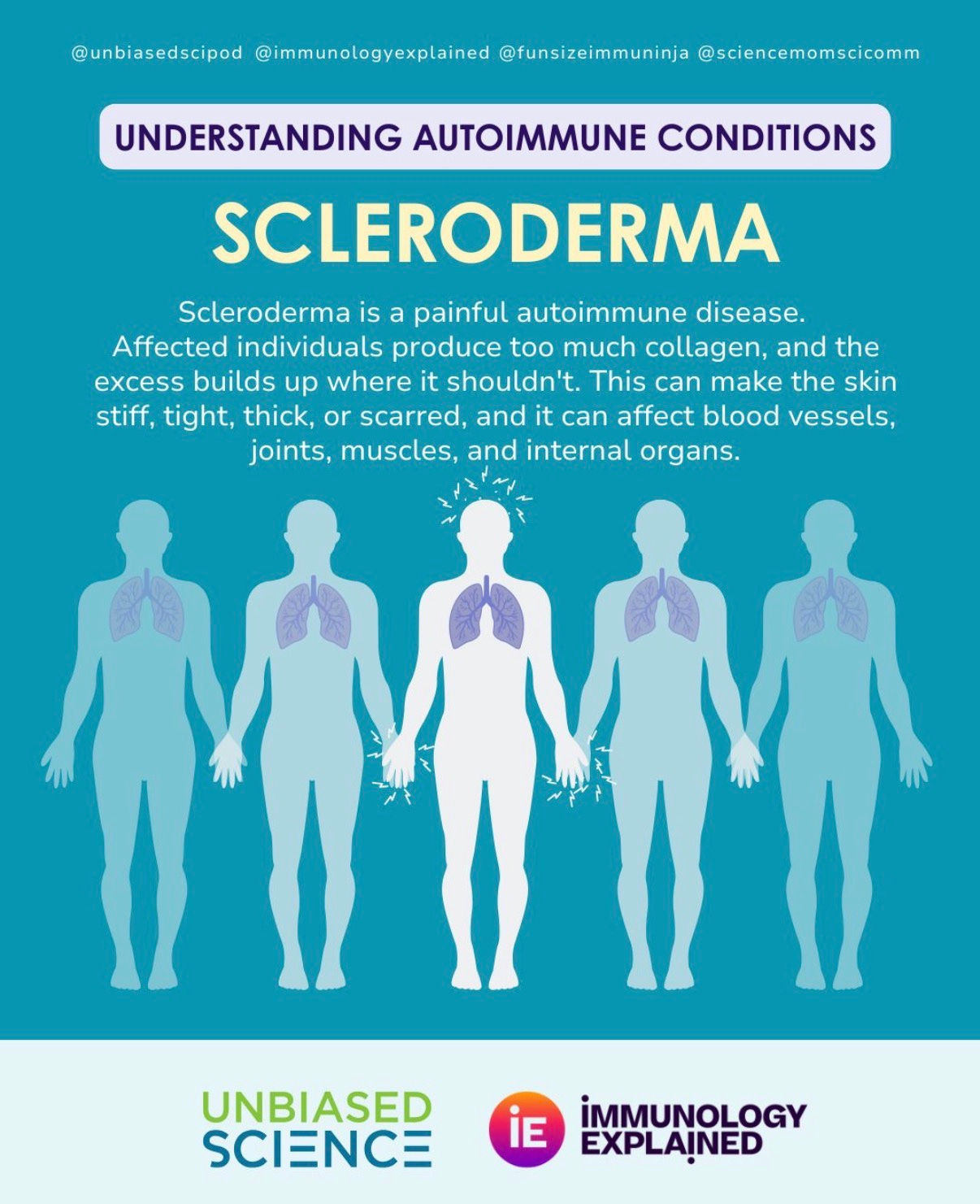
Scleroderma occurs when your body produces too much collagen, which is a strong, fibre-like protein that acts like scaffolding; it gives structure and support to your skin and connective tissues throughout the body. In scleroderma, the body produces too much collagen, causing it to build up where it shouldn’t. This excess can make the skin stiff, tight, thick, or scarred. In some people, the build-up also affects blood vessels, joints, muscles, and internal organs.
There are two main types of scleroderma: Localized and Systemic
Localized Scleroderma is a condition that affects only the skin. It causes one or more patches of skin to become hardened and thickened on different areas of the body. There are several types of localized scleroderma, and their severity can vary widely, ranging from mild, limited skin changes to more extensive areas of involvement.
Systemic Scleroderma affects internal organs, as well as the skin. There are two main types under the category of systemic scleroderma: limited and diffuse.
Limited cutaneous systemic sclerosis is a form of systemic sclerosis that typically develops gradually over time. It primarily affects certain areas of the skin, most commonly the hands and face, where individuals may develop telangiectasias, also known as broken or widened blood vessels. Although skin involvement is usually limited, internal organs can also be affected. The lungs are a particular concern, as some people may develop pulmonary hypertension, a condition characterized by high blood pressure in the blood vessels of the lungs.
Diffuse cutaneous systemic sclerosis is a form of systemic sclerosis that typically develops more rapidly than the limited cutaneous form. It often affects larger areas of the skin, leading to more widespread skin thickening and tightening. In addition to skin involvement, internal organs are commonly affected, particularly the heart and lungs. Because of its potential to impact multiple organ systems, diffuse cutaneous systemic sclerosis generally requires close medical monitoring and management.
Sine sclerosis is a rare form of systemic sclerosis in which there is little to no noticeable skin thickening or hardening. Despite the absence of significant skin involvement, the disease can still affect internal organs, such as the lungs, heart, gastrointestinal tract, or kidneys. Because it lacks the characteristic skin changes seen in other forms of scleroderma, sine sclerosis can be more difficult to recognize and diagnose.
What Scleroderma looks and feels like
For most people, scleroderma causes skin symptoms, such as patches of thick, hard skin that may become discoloured, itching, and tight skin that makes it harder to move your joints. Hard lumps of calcium may also deposit under the skin and tiny blood vessels (spider veins) or spots may appear just beneath your skin (telangiectasia). Painful sores may also form on fingers and toes (digital ulcers).
Localized scleroderma may develop gradually over months, or erupt more quickly over a period of a few weeks.
· Skin changes: itchy, burning, or sore. Thickened skin may become fixed and ‘stuck down’ across a joint such as the wrists, ankles, knees or elbows, restricting growth and mobility.
· Deep tissue involvement: deeper tissues on the face can lead to distortion of the natural facial contour and altered facial appearance. This may also result in fatigue, joint pain and muscle aches. Hair loss over the affected area may occur as well as headaches and more rarely, epilepsy. The eyes and teeth may occasionally also be affected.
Systemic Sclerosis often develops with Raynaud’s as the first symptom. It may come well before other symptoms - up to 10 years before. Other symptoms include:
· Skin changes: Skin can be itchy, tight and/or hardened, often around joints. Tiny calcium deposits can develop under the skin. Painful sores on fingers and toes (digital ulcers) may develop. Tiny blood vessels (spider veins) or spots appearing just beneath your skin (telangiectasia).
· Muscles: Poor functioning of the muscles in the upper and lower oesophagus can make swallowing difficult and allow stomach acids to back up into the oesophagus, leading to acid reflux, heartburn, inflammation and scarring of esophageal tissues.
· Organ involvement: Scarring or fibrosis occurring within the GI tract. Scarring or fibrosis may occur within the lungs. Heart involvement, for most, is often mild and very difficult to be sure whether it is present or not. For others heart involvement may be more severe. Like the heart, kidney involvement is variable and often mild. The eyes and teeth can occasionally be affected.
Piecing together a diagnosis
Many diagnosis journeys are a long and frustrating one. As you’ve learned, Scleroderma can take many different forms and affect different parts of the body, which can make it difficult to diagnose. It can take years to receive a proper diagnosis, often after new and/or progressed symptoms begin to develop. Some have experience of, sadly, not being taken seriously or being dismissed by healthcare professionals. And a delayed diagnosis can cause irreversible emotional and physical toll and damage.
Women make up 80% of scleroderma cases. My diagnosis of Systemic Scleroderma started with calling my general practitioner (GP) to express how my raynaud’s has worsened: even a short walk on a warm autumn day turned my fingers pale, cold and numb. Luckily, I was taken seriously by my GP, and was referred to a specialist right away - likely because I already had an pre-existing autoimmune disease - autoimmune hepatitis - and it’s common for people with autoimmune diseases to have more than one.
This took me down a path of visiting a new specialist - a rheumatologist, a physician specialized in diagnosing and treating conditions that affect the joints, bones, muscles and immune system. My rheumatologist analyzed additional blood work, checked physical symptoms (like pinching the skin), a skin biopsy, and even a test where the doctor looks at the bed of your fingernails through a microscope - called a nail fold capillaroscopy.
Systemic sclerosis can be difficult to diagnose as it often develops gradually. Many people live with unexplained symptoms for years before receiving a diagnosis. There is no single test or feature which gives a yes or no answer. Instead, the diagnosis is made after looking at the whole person, taking into account their symptoms, physical examination and clinical tests.
Combining several elements can lead to a diagnosis of Scleroderma and differentiate between Localized and Systemic Scleroderma.
· Blood tests for anti-nuclear antibody and biomarkers
· Blood pressure tests
· Skin biopsies
· Nailfold Capillaroscopy
· Imaging, including X-rays and CT scans
· Organ-specific testing for the heart (echocardiogram), GI tract (endoscopy), lungs (pulmonary function tests)
· Additional symptoms might include evaluation for gag reflux problems and Raynaud’s phenomenon
I’m incredibly fortunate in that my doctors believe the disease hasn’t progressed significantly. That’s why staying on top of symptom management is so important - it’s how we catch any early signs of change before anything becomes harder to address.
Living with that uncertainty can be scary at times. But I’ve also found it can be a powerful motivator. When my future feels unpredictable or uncertain, it drives me to achieve what I want to accomplish in my life, and serves as a fuel and reminder of what truly matters in life.
Treatments for Scleroderma
There is no cure for scleroderma and because scleroderma is complex, treatment can also be complex: treatment requires a team of different healthcare professionals.
The aim of treatment is to stop progression, shorten the duration of disease and avoid tissue damage. Treatment will be tailored to individual needs, depending on what type of scleroderma someone has and how it affects their body.
Treatments for Scleroderma include targeted treatments for the systems involved in the disease to manage symptoms.
· Skin. Topical treatments or creams can help with tightness or dryness of the skin. In severe cases immunosuppressants can help with these symptoms (mycophenolate, cyclophosphamide or methotrexate). In some cases intravenous immunoglobulin (IVIG) may also be used. UVA-1 phototherapy is also used at times.
· Raynaud’s Phenomenon. Blood pressure medications including calcium channel blockers (amlodipine or nifedipine), Angiotensin receptor blockers (losartan or valsartan), or Phisphodiesterase-5 (PDE-5) inhibitors (sidenafil or tadalafil) are used to dilate blood vessels and improve circulation which can prevent digital ulcers.
· Gastrointestinal Symptoms. Proton pump inhibitors can help manage severe heartburn and acid reflux (omerprazole, pantoprazole). If there are also intestinal motility issues, medications that ease bloating or constipation can also help (psyllium, loperamide, linaclotide).
· Lung complications. Immunosuppressants are often used if patients develop interstitial lung disease. Nintedanib was approved in 2019 to treat scleroderma-associated lung disease and works by inhibiting a combination of enzymes to slow lung fibrosis. Another medication approved in 2021, called tocilizumab, that inhibits a pro-inflammatory cytokine called IL-6 that reduces lung inflammation.
· Kidney complications. Kidney crises can be managed with blood pressure medications like ACE inhibitors (captopril).
· Pain & Joint Swelling. NSAIDs (non-steroidal anti-inflammatory drugs) are the first line treatment to manage these symptoms. Corticosteroids can also be used to relieve inflammation and pain.
· Non-medication treatments. Additional treatments may benefit patients with scleroderma including physical or occupational therapy to maintain joint mobility and muscle weakness. Treatments to manage effects of the disease may also include fat transfer or fillers or involvement of surgeons to treat joint contractures or limb asymmetry.
Emerging treatments
There are several new treatments in development for scleroderma.
· CAR T-cell therapy. An immunotherapy that involves removing a patient’s own T cells and reprogramming them to target a specific molecule on a cell of interest and infusing them back into the patient. While this is commonly done for patients with cancers of B cell origin, this type of personalized immunotherapy is now proving to be useful for some autoimmune diseases. For Scleroderma, a similar approach would be used to deplete the patient’s B cells for refractory disease. This may be more long-acting than some antibody-based immunotherapies such as rituximab.
· Targeted Biologics. Biologics that bind and block the interferon receptor, others that result in B-cell inhibition, and some that modulate T cells may be used. The combination of several agents aimed to modulate the immune system may work together with immune suppressants to provide improved effects.
· Anti-fibrotic medications. Bispecific antibodies or antibodies that have been fused together to target more than one specific molecule can target multiple pathways simultaneously, including those that drive fibrosis as well as those driving immune cell activation.
· Biomarkers. Research is continuing to focus efforts on discovering biomarkers that may be used for risk stratification and disease classification.
Final Thoughts
Living with autoimmune diseases has taught me that so much is still possible - even when it doesn’t feel that way.
The truth is, I’ve worked hard to get here. After my diagnosis, I made it my priority to understand my body more deeply - learning which treatments worked, which habits helped, and how to advocate for myself.
And as strange as it might sound, I have a lot to thank my diagnosis for.
Without it, I likely wouldn’t have become so focused on my health. I likely wouldn’t have pursued a career in health promotion, a role in patient and public involvement, or found my way into science communication. I likely wouldn’t have found my lifelong partner or discovered who my true friends are - the ones who show up, no matter what.
And I truly don’t think I’d be who I am today. Driven, empathetic, passionate, with a zest for life. Someone who gets to hear from others that I’ve inspired them to advocate for their own health.
My diagnosis is often my fuel. And for that, I’m grateful.
I don’t think a diagnosis should define us. So I decided, from the very start, that it wouldn’t define me.
-April English
Resources for Scleroderma Support:
National Scleroderma Foundation
Scleroderma Research Foundation